|
|
Executive Times |
|||
|
|
|
|||
|
|
|
|||
|
|
2008 Book Reviews |
|||
|
|
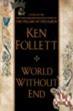
World
Without End by Ken Follett |
|||
|
Rating: |
*** |
|||
|
|
(Recommended) |
|||
|
|
|
|||
|
|
Click
on title or picture to buy from amazon.com |
|||
|
|
|
|||
|
|
Plague Weighing
in at about three pounds and over 1,000 pages, Ken Follett’s follow-up novel to
Pillars of the Earth is titled World
Without End, and is also set in Kingsbridge, two hundred years after the
earlier novel. 14th century England comes alive for readers on
these pages, plague and all. In typical Follett style, he uses the
development of a cast of characters to present a comprehensive view of life
at that time, and uses their work and their relationships to explain their
world. Here’s an excerpt, from the beginning of Chapter 3, pp. 28-31: Caris's home was a luxurious
wood-frame building with stone floors and a stone chimney. There were three
separate rooms on the ground floor: the hall with the big dining table, the
small parlor where Papa could discuss business privately, and the kitchen at
the back. When Caris and Gwenda walked in, the house was full of the
mouthwatering smell of a ham boiling. Caris led Gwenda through the
hall and up the internal staircase. "Where are the puppies?" said
Gwenda. "I want to see my mother
first," Caris replied. "She's ill." They went into the front
bedroom, where Mama lay on the carved wooden bedstead. She was small and
frail: Caris was already the same height. Mama looked paler than usual, and
her hair was not yet dressed, so it stuck to her damp cheeks. "How are you
feeling?" Caris said. "A little weak,
today." The effort of speaking made Mama breathless. Caris felt a familiar, painful
jumble of anxiety and helplessness. Her mother had been ill for a year. It
had started with pains in her joints. Soon she had ulcers inside her mouth
and unaccountable bruises on her body. She had felt too weak to do anything.
Last week she had caught a cold. Now she was running a fever and had trouble
in catching her breath. "Is there anything you
need?" Caris asked. "No, thank you." It was the usual answer, but
Caris felt maddened by powerlessness each time she heard it. "Should I
fetch Mother Cecilia?" The prioress of Kingsbridge was the only person
able to bring Mama some comfort. She had an extract of poppies that she mixed
with honey and warm wine that eased the pain for a while. Caris regarded
Cecilia as better than an angel. "No need, dear," Mama
said. "How was the All Hallows service?" Caris noticed how pale her
mother's lips were. "Scary," she said. Mama paused, resting, then said:
"What have you been doing this morning?" "Watching the
archery." Caris held her breath, frightened that Mama might guess her
guilty secret, as she often did. But Mama looked at Gwenda.
"Who is your little friend?" "Gwenda. I've brought her
to see the puppies." "That's lovely." Mama
suddenly looked tired. She closed her eyes and turned her head aside. The girls crept out quietly. Gwenda was looking shocked.
"What's wrong with her?" "A wasting disease."
Caris hated to talk about it. Her mother's illness gave her the unnerving
feeling that nothing was certain, anything could happen, there was no safety
in the world. It was even more frightening than the fight they had witnessed
in the forest. If she thought about what might happen, and the possibility that
her mother might die, she suffered a panicky fluttering sensation in her
chest that made her want to scream. The middle bedroom was used in
summer by the Italians, wool buyers from Florence and Prato who came to do
business with Papa. Now it was empty. The puppies were in the back bedroom,
which belonged to Caris and her sister, Alice. They were seven weeks old, ready
to leave their mother, who was growing impatient with them. Gwenda gave a
sigh of joy and immediately got down on the floor with them. Caris picked up the smallest of
the litter, a lively female, always going off on her own to explore the
world. "This is the one I'm going to keep," she said. "She's
called Scrap." Holding the little dog soothed her, and helped her forget
about the things that troubled her. The other four clambered all
over Gwenda, sniffing her and chewing her dress. She picked up an ugly brown
dog with a long muzzle and eyes set too close together. "I like this one
she said. The puppy curled up in her lap. Caris said: "Would you
like to keep him?" Tears came to Gwenda's eyes.
"Could I?" "We're allowed to give
them away." "Really?" "Papa doesn't want any
more dogs. If you like him, you can have him." "Oh, yes," Gwenda
said in a whisper. "Yes, please." "What will you name
him?" "Something that reminds me
of Hop. Perhaps I'll call him Skip." "That's a good name."
Skip had already gone to sleep in Gwenda's lap, Caris saw. The two girls sat quietly with
the dogs. Caris thought about the boys they had met, the little red-haired
one with the golden brown eyes and his tall, handsome younger brother. What
had made her take them into the forest? It was not the first time she had
yielded to a stupid impulse. It tended to happen when someone in authority
ordered her not to do something. Her aunt Petranilla was a great rule-maker.
"Don't feed that cat, we'll never get rid of it. No ball games in the house.
Stay away from that boy, his family are peasants." Rules that
constrained her behavior seemed to drive Caris crazy. But she had never done
something this foolish. She felt shaky when she thought of it. Two men had
died. But what might have happened was worse. The four children might have
been killed, too. She wondered what the fight had
been about, and why the men-at-arms had been chasing the knight. Obviously it
was not a simple robbery. They had spoken about a letter. But Merthin had
said no more about that. Probably he had learned nothing further. It was just
another of the mysteries of adult life. Caris
had liked Merthin. His boring brother, Ralph, was just like every other boy in Kingsbridge, boastful
and aggressive and stupid, but Merthin seemed different. He had intrigued her right from the start. Two new friends in one day, she
thought, looking at Gwenda. The little girl was not pretty. She had dark
brown eyes set close together above a beaky nose. She had picked a dog that
looked a bit like her, Canis realized with amusement. Gwenda's clothes were
old, and must have been worn by many children
before her. Gwenda was calmer now. She no longer looked as if she might burst into tears at
any moment. She, too, had been soothed by the puppies. There was a familiar lopsided
tread in the hall below, and a moment Ater a voice bellowed: "Bring me a
flagon of ale, for the love of the saints, I've got a thirst like a cart
horse." "It's my father,"
Canis said. "Come and meet him." Seeing that Gwenda looked anxious,
she added: "Don't worry, he always shouts like that, but he's really
nice." Follett
gives readers a lot of words for their dollars, and the entertainment in World
Without End can be enjoyed for weeks on end, in long or short sittings. Steve
Hopkins, June 20, 2008 |
|||
|
|
|
|||
|
Go to Executive Times Archives |
||||
|
|
||||
|
|
|
|||
|
|
The recommendation rating for
this book appeared in the July 2008 issue of Executive Times URL for this review: http://www.hopkinsandcompany.com/Books/World Without End.htm For Reprint Permission, Contact: Hopkins & Company, LLC • E-mail: books@hopkinsandcompany.com |
|||
|
|
|
|||
|
|
|
|||